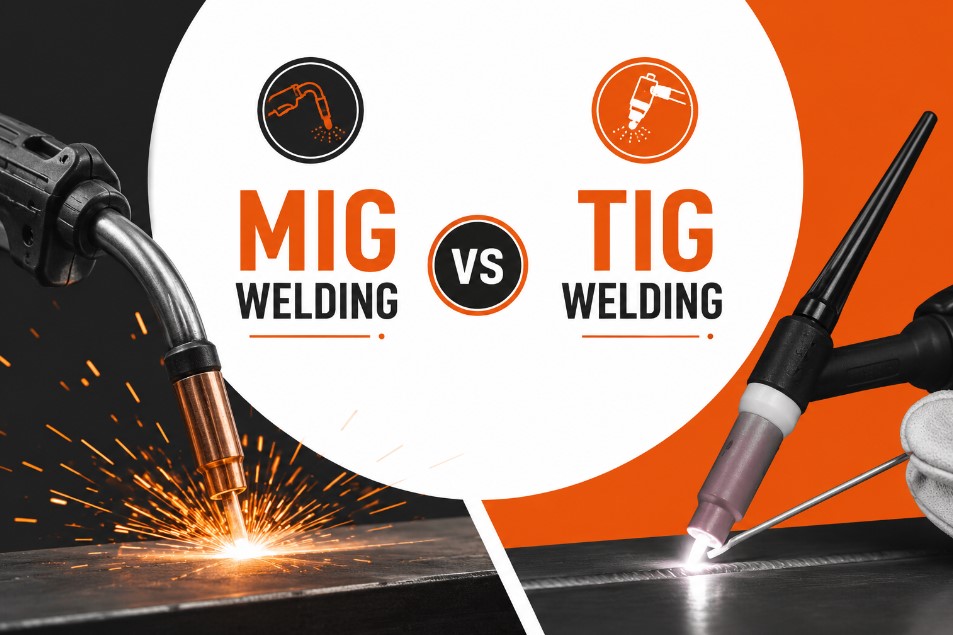
If you need a metal repair or fabrication job done, you’ve probably heard the terms MIG and TIG thrown around. A common question we get asked in the workshop is, “Which is best?”
The truth is, “best” entirely depends on the material, thickness, finish required, budget, and timeline. A process that works perfectly for a heavy structural steel frame might blow right through a thin aluminium car panel.
Here at Mark Steel Fabrication, we have 31 years of experience handling both MIG and TIG welding. We offer workshop-based fabrication and a fully mobile welding service across Essex. Because our team is equipped to do both, we’ll always recommend the process that genuinely suits your specific job, rather than just what happens to be set up on the machine.
Don’t have time to read the full breakdown? Here is a rapid summary:
If you want us to sanity-check your project and recommend the right approach, just give us a bell.
To understand which is right for your project, it helps to know how they work.
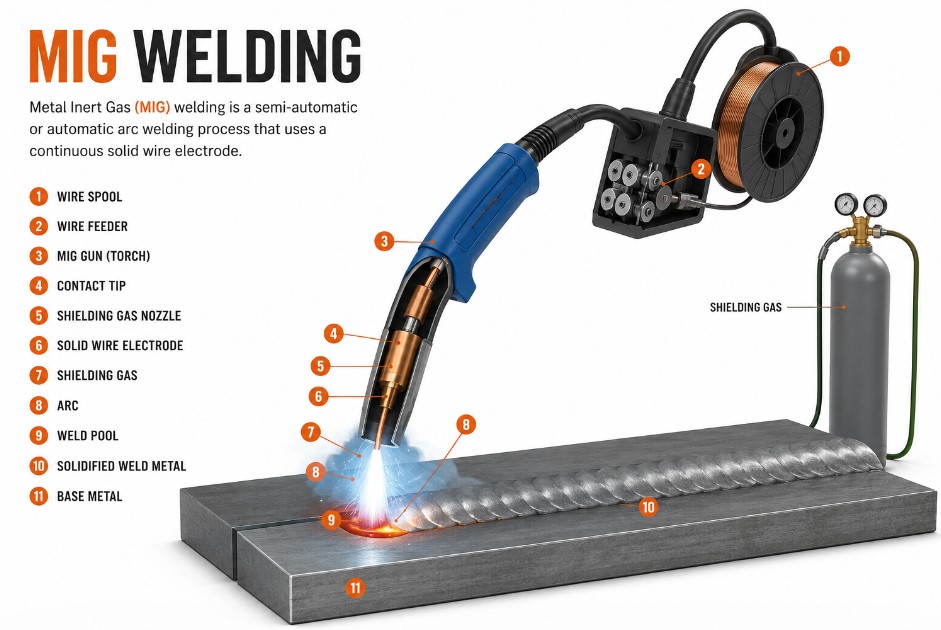
The MIG process uses a continuous wire feed that acts as both the electrode and the filler metal. As the wire feeds through the welding gun, an electrical arc melts it, joining the base metals together. A shielding gas flows out of the gun to protect the weld pool from contamination.
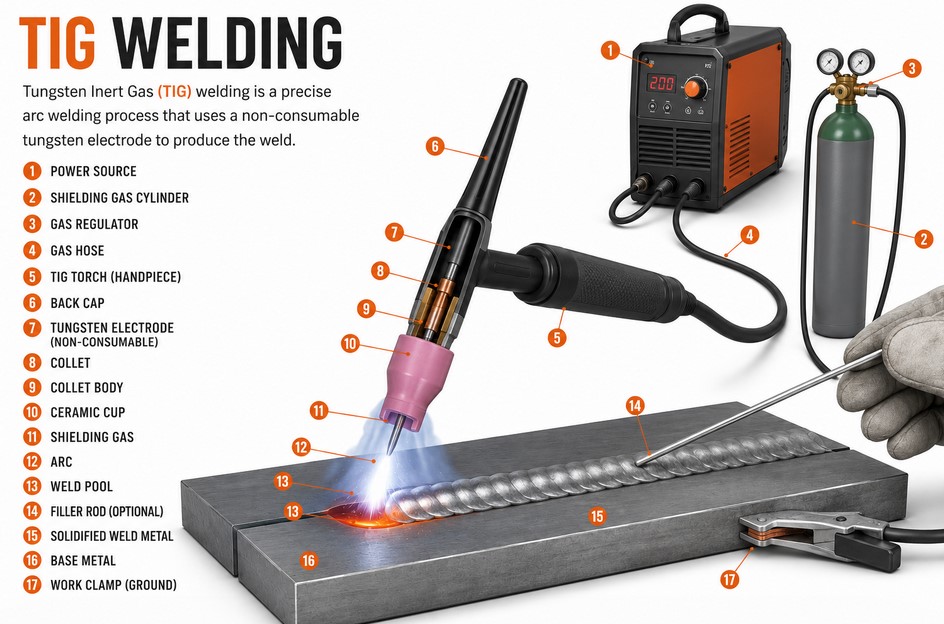
TIG welding — also known as gas metal arc welding or gas tungsten arc welding (GTAW) is a bit different. Throughout this process, the TIG welder uses a non-consumable tungsten electrode to create the arc and melt the base metal. If filler metal is needed, the welder feeds it into the puddle by hand with a separate rod. Like MIG, it also uses a shielding gas to protect the weld.
In practice, MIG is often described as a “point-and-shoot” process. While it definitely still requires skill to get the settings and travel speed right, the machine feeds the wire for you. This allows for quick, continuous welding.
TIG requires significant two-hand coordination. You control the torch with one hand, feed the rod with the other, and often control the heat with a foot pedal. It demands more patience, a cleaner workspace, and meticulous metal preparation.
People often search online to find out: is MIG welding stronger than TIG welding?
In the real world of metal fabrication, joint design, metal preparation, penetration, and correct machine settings matter far more than the label on the welding machine.
MIG is brilliant for achieving strong, deep-penetrating welds quickly, especially on thicker mild steel. TIG, on the other hand, offers unmatched control over heat input and fusion. This makes TIG the stronger, safer choice for thin sections where MIG might overheat the metal or cause distortion.
Failure usually comes down to poor fit-up, dirt in the weld, the wrong filler wire, or poor gas coverage—not the choice of MIG vs TIG. For structural brackets in mild steel, MIG will give you a rock-solid joint. For thin sheet repairs or high-end stainless fabrication, TIG ensures a strong, defect-free finish.
If your project is going to be highly visible, aesthetics matter. TIG typically wins hands-down for appearance. When done well, a TIG weld looks like a neat “stack of coins”. It produces virtually no spatter and requires very little clean-up.
That said, MIG can look incredibly tidy too, especially with the right technique. The catch is that MIG does produce some spatter, which might require grinding or sanding before painting. Of course, not every weld needs to be a beauty pageant contestant. If a bracket is getting ground flat and powder-coated, the initial appearance of the bead is less important than its structural integrity.
Because MIG is a faster, continuous process, it requires less labour time. This usually makes it the more cost-effective option for large or heavy fabrication jobs.
TIG is slower and fussier. The metal needs to be meticulously cleaned before welding, and the process itself takes more time. Plus, materials commonly TIG welded—like aluminium and stainless steel—are inherently more expensive to work with.
If you have a hidden or painted weld on a mild steel repair, MIG is the sensible, budget-friendly choice. If it’s a visible stainless steel feature for a commercial kitchen, TIG is absolutely worth the extra investment.
Not sure how this impacts your budget? Send us a photo of what you need doing, and we can provide a quick, no-obligation quote.
Here is a quick cheat sheet on when we prefer to use each method in the workshop.
Working on-site introduces challenges like wind, which can blow away the shielding gas required for both MIG and TIG. Fortunately, we offer mobile welding across Essex and are well-versed in handling site conditions. We can adapt our equipment, use windbreaks, or utilise flux-cored wire if the weather simply won’t cooperate with standard gas setups.
At Mark Steel Fabrication, our fully equipped workshop handles a massive variety of metals. We provide MIG and TIG welding from 0.5 mm up to 30 mm plate.
We can also crop and punch 15 mm plate, plasma cut 35 mm plate, and offer MMA welding up to 20 mm plate and oxy fuel cutting up to 100 mm thick.
Essentially, if it’s metal, we can cut it, fold it, and weld it. Thin sheet requires lower heat input to avoid warping, which is where TIG shines. Thick plate needs heavy penetration, which is where our heavy-duty MIG setups take over.
Still on the fence? Ask yourself these questions:
If you tell us what you’re making—and ideally send over a photo or a drawing—we can point you in the right direction and get your project moving.
What’s the difference between MIG and TIG welding?
MIG uses a continuously fed wire to join the metals, making it faster and easier to operate. TIG uses a non-consumable tungsten electrode and requires the welder to manually feed a separate filler rod, offering more precision but at a slower pace.
Is MIG welding stronger than TIG welding?
Not necessarily. Both create incredibly strong joints when performed correctly on the right materials. TIG is often better for thin metals to prevent heat damage, while MIG provides excellent penetration for thick steel.
Is MIG welding better than TIG?
Neither is universally better. MIG is better for speed, cost-effectiveness, and thick materials. TIG is better for precision, cleanliness, and thin or exotic metals like aluminium.
Which is easier to learn: the MIG or TIG?
MIG is generally considered much easier to learn because the machine feeds the filler wire for you. TIG requires complex coordination between both hands and often a foot pedal.
Which is best for thin metal?
TIG is usually the best choice for thin metal because the welder has precise control over the heat input, reducing the risk of warping or burning through the material.
Which is best for stainless steel?
TIG is widely preferred for stainless steel, especially when the finish will remain visible, as it leaves a very clean, aesthetically pleasing weld with minimal clean-up required.
Which is best for aluminium?
While you can MIG weld aluminium with the right setup, TIG is the industry standard for high-quality aluminium fabrication due to the precise heat control required.
Why does TIG often cost more?
TIG is a slower process that requires meticulous metal preparation, more expensive shielding gases, and highly skilled labour, all of which drive up the final cost.
Can you do MIG or TIG welding on-site (mobile welding)?
Yes. We offer a mobile welding service across Essex. We bring the right equipment to ensure the weld is protected from the elements and performed to a high standard, even outside a workshop.
How do I get a quote from a MIG welder?
Simply give us a call or send us an email with a few details about your project, and we’ll provide a free, no-obligation quote.
If you’re weighing up MIG vs TIG welding for a repair or fabrication job in Essex, we’re happy to help. Whether you need a small domestic repair or a complete commercial steel fabrication package, our team has the tools and the 31 years of experience to get it done right.
Give us a call or email, send over a few photos or dimensions if you have them, and we’ll point you towards the most sensible option and provide a no-obligation quote.
