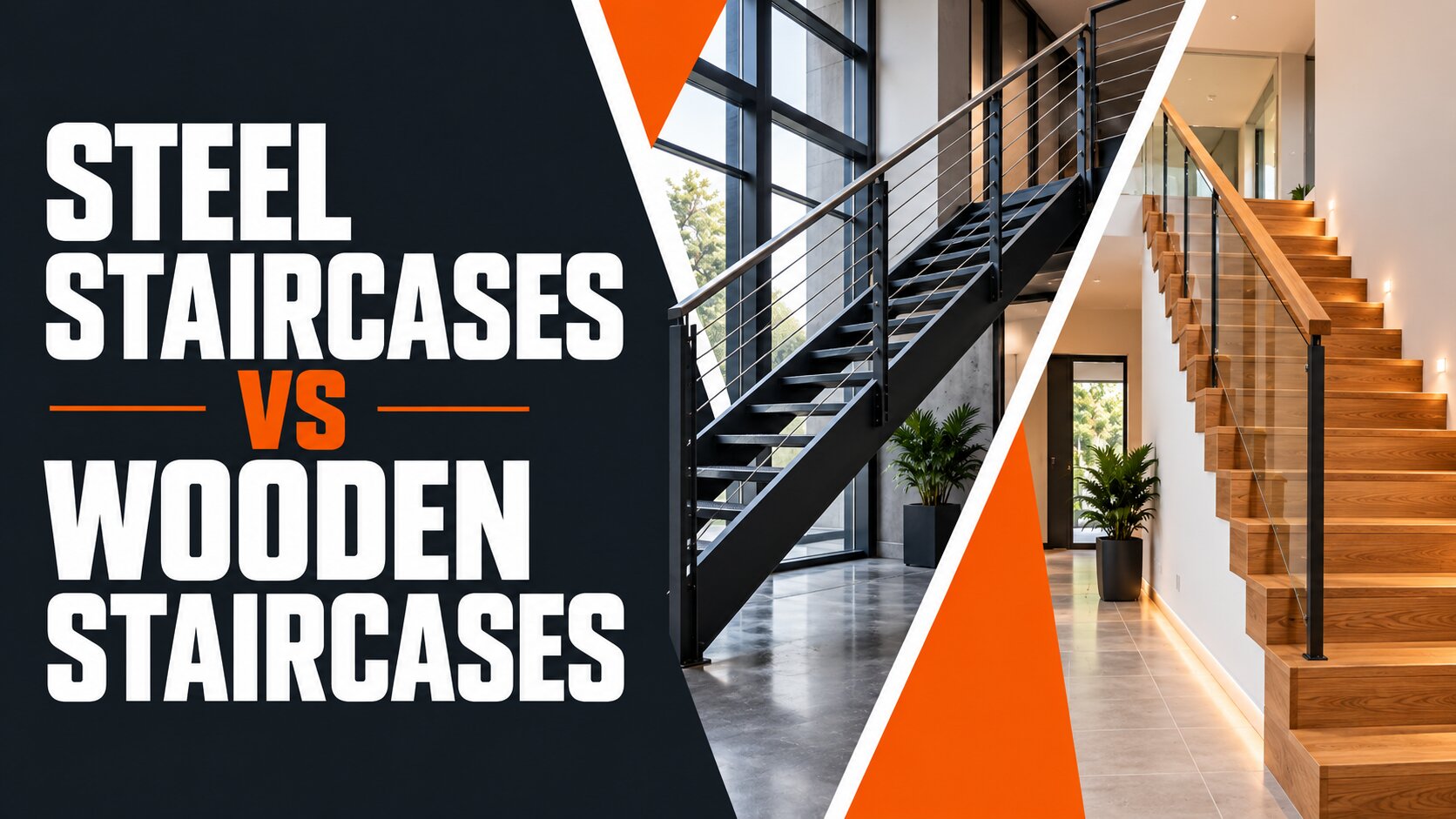
For high-traffic and commercial spaces, steel staircases usually win on strength, low maintenance, and longevity. Wooden staircases still shine in traditional homes where warmth and character matter most. The right choice comes down to how the stairs will be used, where they’ll live, and how much upkeep you’re willing to take on.
Stairs are one of those things nobody thinks about until they start creaking, scuffing, or wobbling underfoot. Then, suddenly, they’re all you can think about. If you’re weighing up steel staircases vs wooden staircases for a project, you want a clear answer without wading through pages of fluff.
We’re Mark Steel Fabrication, local Essex welding experts and specialists in the design and build of all aspects of metalwork. With 31 years of experience behind us, we’ve seen plenty of stairs come and go — and we’ve built a fair few that are still going strong. Here’s our honest take on how the two materials stack up on strength, maintenance, design, and longevity.
If you’re running a busy site, strength and maintenance tend to make the decision for you.
This is where steel flexes its muscles. Steel has a fantastic strength-to-size ratio, which means slimmer profiles, longer spans, and a staircase that shrugs off constant footfall without so much as a groan. It won’t warp, crack, or bend under pressure, which is exactly why it’s the go-to for commercial properties and anywhere with heavy use.
Wood is strong too — don’t write it off. A well-built hardwood staircase in oak, maple, or walnut can happily handle a family home for years. But its strength depends on the species, the thickness, the quality of the joinery, and the environment it lives in. Under heavy or frequent loads, timber steps can eventually bend, split, or work loose.
Best for: steel for busy, high-load environments; wood for a warm residential feel when it’s properly built.
Here’s the bit people tend to forget when they’re staring at the initial price tag. A staircase isn’t a one-off cost — it’s something you look after for years.
Steel is refreshingly low-fuss. A protective finish keeps rust at bay, and day-to-day care is really just a quick wipe-down and the occasional check on the fixings. Powder coating adds another layer of protection and can be touched up if it ever gets tired. In a commercial setting, that might mean a monthly clean and an annual once-over. Job done.
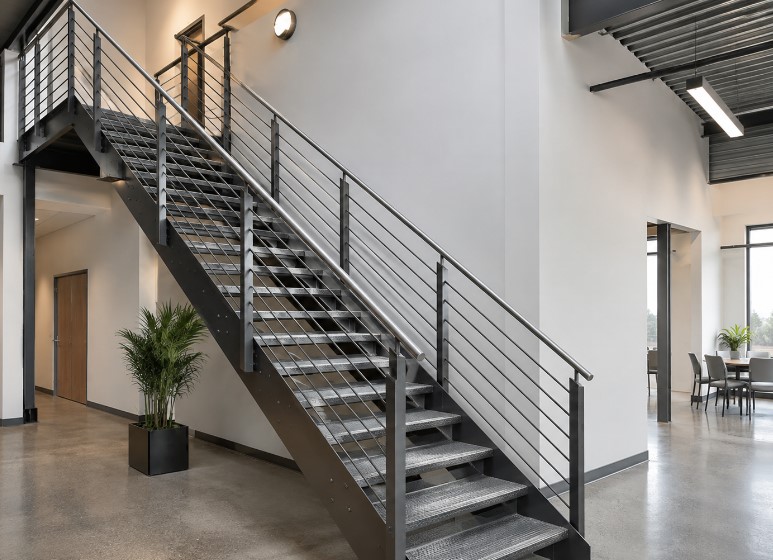
Wood asks for more attention. It picks up scratches, dents, and scuffs, and it can develop that telltale squeak over time. Timber is also sensitive to humidity, so it may swell, warp, or loosen if conditions swing about. To keep it looking its best, you’ll need to sand, oil, or reseal it periodically — and refinish it entirely every few years.
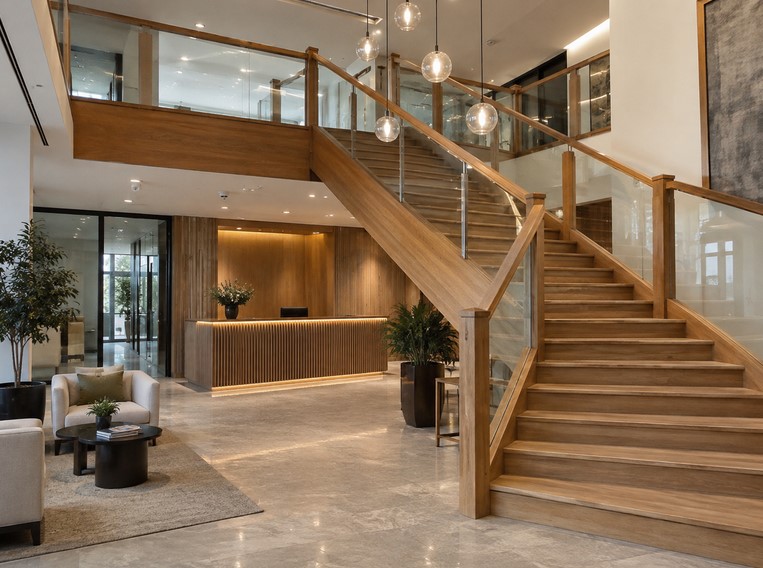
Both materials give you plenty to play with, but steel is the more flexible partner. We can fabricate straight flights, spirals, switchbacks, and slimline floating looks, all tailored to awkward spaces. It suits that clean, industrial-modern aesthetic beautifully, and it can be powder coated in just about any colour you fancy.
Wood, meanwhile, brings warmth and a timeless character that’s hard to beat in a traditional interior.
The good news? You don’t always have to choose. A steel frame with wooden treads gives you the best of both worlds — the strength and slim profile of steel, with the warmth of timber underfoot. Pair that with a glass, steel, or timber balustrade and you’ve got a bespoke staircase that’s as practical as it is good-looking.
A properly fabricated steel staircase with a good protective finish can last for decades with minimal upkeep. That makes it a smart long-term investment, especially in high-use environments where a weaker material would show its age fast.
Wood can also last a long time, but its lifespan leans heavily on the timber species and how well it’s maintained. Skip the upkeep and you’ll be looking at repairs — or a replacement — sooner than you’d like.
When you’re comparing costs, think whole-life rather than upfront. Factor in maintenance, potential downtime, and repairs, and steel often works out the more economical choice over time.
For most commercial settings, yes. If your stairs are used all day, every day, steel is usually the sensible choice.
Steel delivers consistent, reliable performance under constant footfall, and its durable finishes stand up to knocks, scuffs, and the general wear and tear of a busy site. It’s easy to keep clean, quick to inspect, and anti-slip nosings can be built in for added safety. When you’re dealing with warehouses, offices, retail units, or hospitality spaces, that combination of strength and low maintenance is hard to argue with.
If you’re searching for Essex steel staircases that can keep up with a demanding environment, steel is where we’d point you first.
Steel isn’t always the answer, and we’d never pretend otherwise. In a heritage home or a traditional interior, a beautifully crafted wooden staircase can be exactly right. There’s a warmth underfoot and a certain softness to the feel that timber does better than anything else. Budgets vary widely with wood too, so it can suit a range of projects depending on the species and finish you choose.
Before we recommend anything, we like to understand the full picture. We look at how the stairs will be used, the likely footfall and load, whether they’re indoors or out, the finish you’re after, your timeline, and your budget. Only then can we point you towards the option that genuinely suits your project.
As Essex steel staircases fabricators, we handle everything from design through to installation, working across the county from our fully equipped workshop or on-site when the job calls for it. We also work in conjunction with local building control officers, so you can be confident the finished staircase meets the standards it needs to.
Run through these before you commit:
Do steel staircases rust?
Not if they’re finished properly. A protective coating or powder coat keeps corrosion at bay, and for outdoor use we galvanise the steel for extra protection.
Are steel staircases noisy?
They can be, but it’s easily managed. Adding timber treads, rubber inserts, or anti-slip nosings dampens the sound nicely.
Can you combine steel with wooden treads?
Absolutely — it’s one of our most popular combinations. You get the strength of a steel frame with the warmth of timber underfoot.
Which is safer for high-traffic areas?
Steel, generally. It handles constant use without weakening, and anti-slip features are easy to incorporate.
What’s easier to maintain: steel or wood?
Steel, by a distance. A wipe-down and the odd inspection versus regular sanding, sealing, and refinishing for timber.
Are steel staircases better for businesses?
In most cases, yes. Their strength, durability, and low maintenance make them ideal for busy commercial environments.
Can a steel staircase be made to suit a small space?
Definitely. A spiral or switchback design is perfect for tight spots, and because we fabricate bespoke, we build to your exact dimensions.
Do I need building control approval?
New staircases usually do. We’d always recommend checking with your building control officer or contractor — and we work alongside them to make sure everything’s up to standard.
How long does installation take?
It varies with the design, size, and site, but we’ll always give you a realistic timeframe once we’ve seen what’s involved.
Got a staircase project in mind? Give us a ring or drop us an email at info@essexweldingandfabrication.co.uk.
Whether you’ve already got drawings or just a rough idea and a measuring tape, we’ll help you figure out the best option and provide a free, no-obligation quotation. If you’re after Essex steel staircases built to last, we’re ready when you are.
